The word sounds intimidating. The thing itself is not. Here’s what psychoeducation actually involves, what it doesn’t, and how to tell whether it’s something you’d benefit from.
Psychoeducation is likely to be the missing component of the care when you recently received a diagnosis, or when you have long been living with something that still does not fully make sense to you.
It’s not therapy. It’s not a lecture. It is neither the one nor the other, and when done well, it transforms your relationship to what you are experiencing.Not by fixing anything. By making things make sense.
So What Is Psychoeducation, Actually?
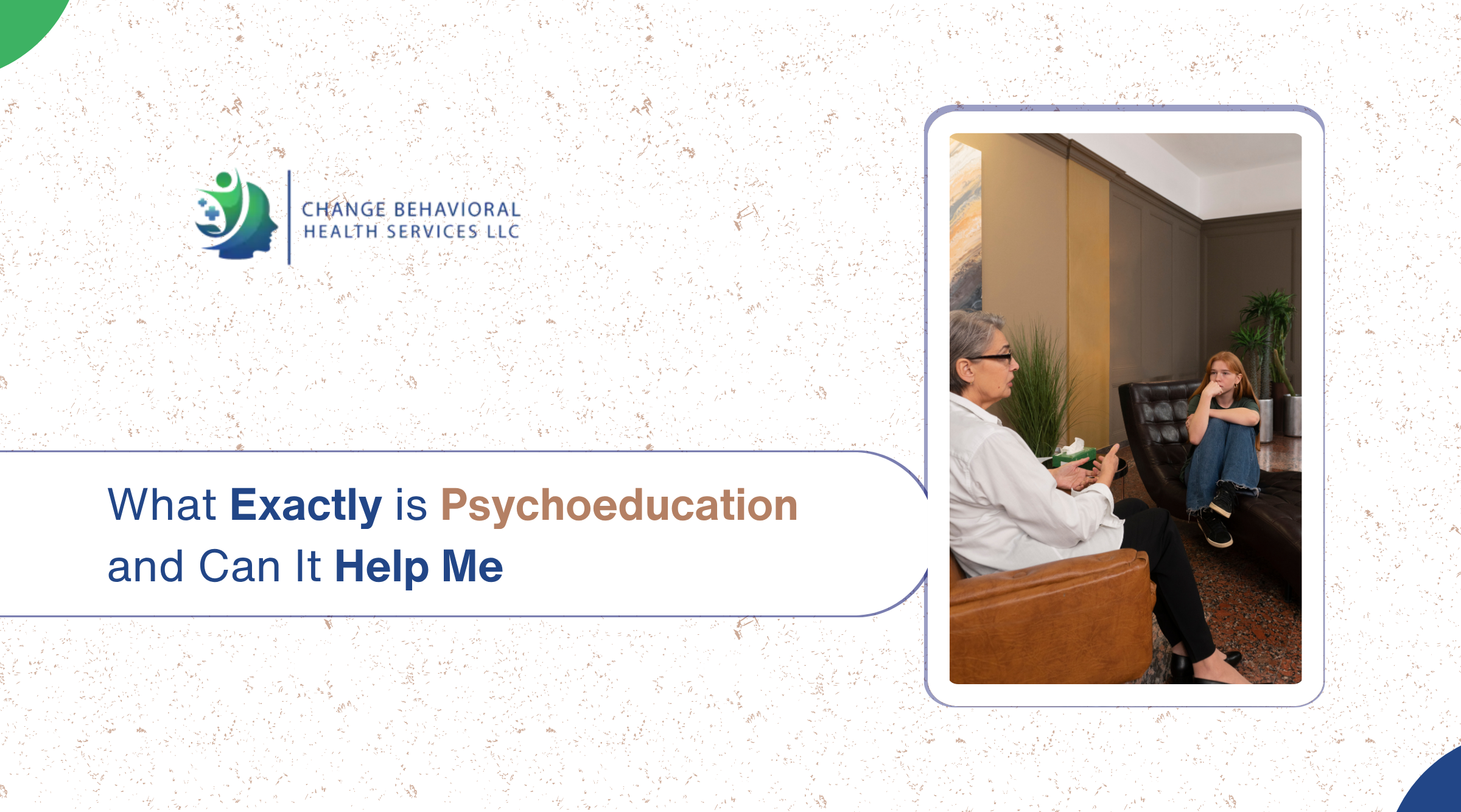
Psychoeducation is structured education about a mental health condition.
A clinician or counselor will take you through the processes of what is going on, why it is going on, what is perpetuating it and what you can do.
You leave knowing more than when you arrived.
Sometimes the term psychoeducation therapy is used when this education is built directly into the therapy session rather than delivered separately.
Either way, it’s not passive. You’re not sitting there while someone reads from a manual. You ask questions. You push back. What you get out of it is specific to your situation, not a generic overview that could apply to anyone.
Where it sits in a care plan
Psychoeducation is rarely the only thing happening. It runs alongside therapy, medication management, or addiction treatment.
Sometimes it’s one-on-one. Sometimes it happens in a psychoeducational group, where several people dealing with similar conditions work through the material together.
The group format adds something the individual format can’t: you hear someone describe your own experience in their words, and that does something.
The difference it makes is concrete.
Someone who knows what their medication is supposed to do, why it takes three weeks to notice anything, and what side effects are normal versus worth reporting, that person handles their treatment differently than someone who was just handed a prescription. That’s not a small thing.
What It Covers Depends on What You’re Dealing With
Psychoeducation doesn’t follow one fixed script.
varies according to the individual, diagnosis and gaps that actually have to be filled. With that said, this is what it tends to look like in the most typical situations.
Examples of psychoeducation across common conditions
Getting past the label
A diagnosis gives you a name for what’s happening. It does not describe how: it functions in your body, why it becomes more severe at some point, what is actually driving it, and what alters it.
Psychoeducation for depression, for example, means learning how disrupted sleep, reduced physical activity, and patterns of negative self-talk feed into each other to keep low mood locked in, and what actually breaks that cycle.
In the case of anxiety, it is to know what the stress response is up to in your body and why some triggers are more effective than others.
In the case of bipolar disorder, it is getting to know your own early warning signals well enough to intervene before an episode has already begun.
That kind of specific knowledge changes how you handle things day to day. It’s not motivation. It’s information.
Psychiatric medication education
This is where psychoeducation makes one of its most practical contributions.
People stop taking psychiatric medications all the time, and the most common reasons aren’t side effects or cost.
They’re: not seeing results fast enough, not knowing whether what they’re feeling is normal, and not knowing how to bring concerns to their prescriber without feeling like they’re complaining.
The psycho-educational component of medication management covers the things that often go unsaid in a standard appointment:
- How the medication works and what it’s actually targeting
- Why some medications take weeks before anything shifts, and what’s happening during that waiting period
- Which side effects are expected and temporary versus which ones need a call to your provider
- What stopping abruptly can do, and why that matters
- How to bring up concerns with your prescriber in a way that actually gets heard
None of that replaces the prescriber conversation. But you have a much better conversation when you already know the basics.
Stress and coping
One thing psychoeducation does well is make stress biology concrete rather than abstract.
Not “you should manage your stress better.” More like: here’s what your nervous system is actually doing when you’re overwhelmed, here’s why certain things set you off more than others, and here are tools that work at that physiological level rather than just trying to think your way through it.
Coping isn’t a personality trait. It’s a set of learned responses. Some people got useful ones growing up; a lot didn’t. Psychoeducation teaches them.
Addiction education
For substance use, psychoeducation tends to be one of the earliest and most important pieces of recovery work.
Many individuals come in with much shame and a notion that addiction is essentially an issue of willpower.
It is not, and knowing what is actually driving it on a biological and psychological basis alters the way one approaches treatment.
It also prevents relapse, which is among the leading causes of giving up following a setback.
Trauma awareness
Trauma has very specific effects on the nervous system. Hypervigilance, emotional numbness, avoidance, difficulty being present in conversations or relationships: these aren’t signs of weakness.
They’re what happens to a brain that had to adapt to something overwhelming.
For a lot of people, just understanding this, getting a clear explanation of why they respond the way they do, loosens something.
The shame around their reactions starts to go.
That matters because shame makes it much harder to do the actual therapeutic work that comes later. Psychoeducation makes that work more accessible.
Knowing what’s happening to you doesn’t cure it. But it changes what you do next. And that’s usually where treatment either gains traction or doesn’t.
Psychoeducation for Families and Caregivers
This is underused, which is a real problem.
When someone in a family has a mental health condition or addiction, everyone in the household is affected.
The partner who doesn’t know what to say after a bad episode. The parent who keeps doing too much and then resenting it.
The sibling who pulls away because they don’t know how to help without making things worse.
None of that comes from not caring. It comes from not knowing.
What family-focused psychoeducation tends to cover:
- What the condition actually looks like from the inside, which is often completely different from how it appears to the people watching
- What helps and what doesn’t, including a lot of well-meaning responses that actually make things harder
- How to be present without absorbing everything, which is genuinely difficult and takes practice
- What a crisis looks like early and what to do before it gets worse
- How to take care of yourself while also staying involved with someone who is struggling
The research here is worth paying attention to.
Studies consistently show that when families of people with schizophrenia, bipolar disorder, depression, and addiction receive psychoeducation, the patients’ clinical outcomes improve. Not just the family’s wellbeing.
Fewer relapses. Longer stretches between hospitalizations. The family’s understanding of the illness has a direct effect on how the illness progresses.
Does It Actually Work?
Worth asking. Mental health has produced a lot of things that sounded good in a brochure.
Psychoeducation has a solid research base. It’s been studied specifically across schizophrenia, bipolar disorder, depression, anxiety, ADHD, and substance use disorders. What the studies show:
- People who receive psychoeducation are more likely to stay in treatment, take medication consistently, and follow through with therapy
- They report feeling less at the mercy of their condition and more capable of doing something about it
- They catch warning signs earlier and reach out before things escalate
- Relapse rates are lower particularly in conditions like bipolar disorder where relapse is a recurring problem
- Quality of life improves even in cases where symptoms don’t change dramatically, which suggests the benefit is about how you live with the condition, not just reducing its severity
It isn’t a cure. It doesn’t replace medication or therapy. But it makes both of those work better, which matters.
What Psychoeducation Isn’t
Because it’s an unfamiliar term, people sometimes walk in expecting the wrong thing. A few clarifications.
It’s not therapy, though it often runs alongside it
Therapy explores what you’ve been through. It works on patterns, history, relationships, and how you process difficult experiences.
Psychoeducation is more straightforward: here is what’s happening, here is why, here is what you can do about it. The two work well together. But they’re not the same thing, and one doesn’t substitute for the other.
It’s not a one-session orientation
Sitting through a 45-minute intake overview and being handed some handouts is not psychoeducation.
Good psychoeducation is ongoing.
What’s useful to know at the start of treatment is different from what’s useful six months in, or after a relapse, or when life circumstances shift in ways that change how a condition shows up.
It’s not trying to sell you on anything
The point isn’t to convince you your diagnosis is correct or that a particular treatment is the right one. You get accurate information about your situation and you make your own decisions. That’s the whole model.
Who Gets the Most Out of It
Almost anyone in mental health treatment can benefit from it to some degree, but some situations where it makes the clearest difference:
- People who are newly diagnosed and have more questions than their appointments have room for
- People who have been in treatment for a while but feel like they’re following instructions they don’t fully understand, and are starting to check out because of it
- People who keep relapsing and want to understand what’s actually happening rather than just trying harder each time
- People on psychiatric medication who have concerns they’ve never quite figured out how to raise
- Family members and caregivers who are worn down and need their own information, not just support for the person they’re caring for
- People in addiction recovery who need a clear picture of what they’re dealing with before the other work can stick
- People with trauma histories who need to understand their own responses before they can start processing what’s behind them
If more than one of those sounds like you, psychoeducation is probably worth bringing up with your care team if it’s not already part of what you’re doing.
How Change Behavioral Health Handles It
The psychoeducation programs at Change Behavioral Health are built into care from the start, not offered as an optional extra. The idea is simple: you do better in treatment when you understand what you’re being treated for and why each part of the plan matters.
Depending on your situation, that might include:
- Condition-specific education around anxiety, depression, mood disorders, ADHD, trauma or whatever is most relevant to what you’re dealing with
- Medication education so you know what you’re taking, what to watch for and how to communicate with your prescriber when something feels off
- Addiction education covering what drives substance use, what relapse is and isn’t, and what recovery actually requires
- Stress and nervous system work that gets specific to how your body responds rather than staying in general territory
- Family and caregiver sessions for the people around you who are trying to help but need their own information to do that well
- Trauma awareness as groundwork before the deeper processing work starts
Services are available by telehealth across Washington DC, Maryland, and Virginia, and in-person for clients in nursing homes, residential housing, group homes, and addiction treatment facilities.
What care looks like depends on your specific situation, not a predetermined program you get slotted into.
Still Have Questions? Start Here.
Change Behavioral Health Services offers psychoeducation and counseling alongside:
- Psychiatric evaluation
- Med management
- Addiction recovery treatment for adults across DC, Maryland, and Virginia
If you want care that explains what’s happening and not just what to do about it, reach out.