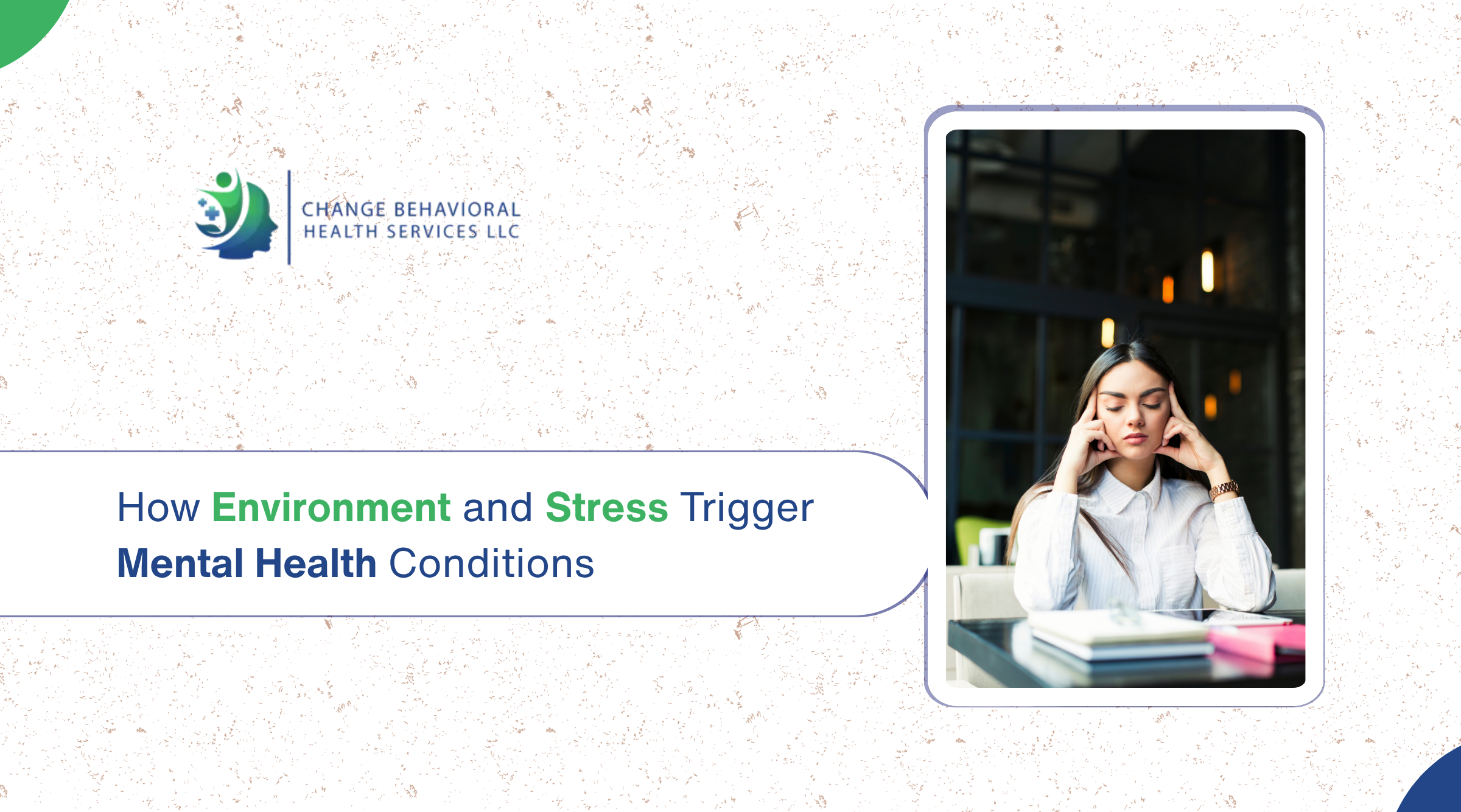
The conversation about mental health tends to stay inside the person. Their brain chemistry. Their genes. Their history. But a lot of what shapes mental health is outside them. In their home, their job, their relationships, the neighborhood they grew up in. This piece is about that part.
There’s a version of the mental health conversation that stays entirely inside the person. The serotonin deficit. The genetic predisposition. The early attachment wound. All of it real, all of it worth understanding. But there’s another layer that doesn’t get enough attention: what’s happening around someone. The conditions they live in. The stressors they carry. The environments they can’t always leave.
Mental health conditions rarely arrive out of nowhere. They develop in context. And that context matters, not just for understanding why someone is struggling, but for figuring out what to do about it.
This is what clinicians are referring to when they ask about your living situation alongside your symptom list. It’s not small talk. The environment tells them things about you that a medication inventory alone never could.
Change Behavioral Health provides support in times of emotional crisis and mental health struggles.
The Body Keeps Score. And the Body Is Always Watching.
Stress isn’t only psychological. It has a biology, and the body experiences it as a physical event.
When the brain registers a threat, whether it’s a car accident or a bad performance review or an unpaid bill, it releases a cascade of hormones, primarily cortisol and adrenaline. Short-term, this is useful. Your heart rate goes up. You’re sharper. You can act. The problem starts when the stressor doesn’t resolve and the cortisol doesn’t come back down.
When the stressor fails to resolve and the cortisol fails to return to normal, this is the beginning of the problem.
Persistent cortisol increase during months or years has actual, quantifiable modifications in the brain. The hippocampus, the memory and emotion regulation segment, physically shrinks when placed under continual stress. The prefrontal cortex, which controls decisions and the ability to put things in perspective, becomes less active. The amygdala, the danger scanning part of the brain, overreacts.
This is what makes individuals who experience chronic stress reactive in a manner that leaves them baffled. Why are they not able to think clearly, even when the stakes are low. Why the low-grade panic that buzzes in the background will not subside, it is not a character defect. It is a nervous system that has long been on high alert.
A bracing body becomes conditioned to remain braced. And after a while, that pose becomes the default position, and it requires actual effort to change positions.
The body also has an inflammatory response. Chronic stress raises systemic inflammation, which scientists now see to be a part of depressive disease. The gut-brain connection is disturbed. Sleep breaks down. Appetite shifts. The impacts are multiplied in such a manner that it is difficult to tell where one issue starts and another one ends.
The Environments That Shape Who Gets Sick
Genetics is a factor in mental health. However, genetic predisposition is not fate. An individual may have a predisposition to depressionor anxiety throughout their entire life and never develop it into a clinical disorder. The one factor that is likely to trigger that vulnerability is the environment.
This is referred to as the stress-diathesis model by researchers. The predisposition is referred to as diathesis. The environment is stressful.
What you grew up in
The development of the stress-response system is based on childhood experiences. In a case where a child is raised in an environment which is truly unsafe, chronically unpredictable, or emotionally depleting, either through abuse, neglect or due to the untreated addiction of a caregiver, or even exposure to domestic violence, the nervous system becomes accustomed to such circumstances. It stays vigilant. It interprets normal situations as threatening.
The resulting adapted system of nervousness in adulthood can appear as a disproportionate feeling of anxiety, inability to trust others, emotional fluctuations that others would struggle to keep up with, or a tendency to engage in coping mechanisms that were initially helpful but now are issues themselves. Childhood setting did not disappear. It went inward.
Financial and material insecurity
One of the most widespread yet underestimated causes of mental disorders in adults is financial stress. And it is not merely the concern over money, which is concern enough by itself. It is the cumulative intellectual burden of impossible trade-offs on a daily basis. Rent or medication. Groceries or copay. Requesting assistance or holding back.
Individuals living in financial instability are also grappling with what is likely to accompany it: a less secure housing situation, increased noise, reduced access to healthy food, reduced choices of care, and a social environment that reflects their own precarity. One factor multiplies the other.
Loneliness and disconnection
Loneliness is often described as a feeling. But it functions like a chronic stressor in the body. Sustained social isolation increases inflammation, disrupts sleep, elevates cortisol, and is consistently associated with higher rates of depression, anxiety, and cognitive decline in research on adults.
This isn’t only about people who live alone or who have lost contact with family. It can be just as present in someone who is surrounded by people but feels unseen by all of them. The quality of connection matters as much as the quantity. And in a culture that tends to underinvest in both, a lot of people are more isolated than they appear.
Work that grinds you down
The mental health research on work stress is consistent on one point: the most psychologically harmful combination isn’t high pressure alone. It’s high pressure paired with low control. When someone is expected to produce results in a system that gives them no real ability to influence their conditions, something breaks down.
Burnout is the name we give to the late stage of that breakdown. It tends to look a lot like depression from the outside, and sometimes it turns into it. Emotional flatness, withdrawal, cynicism, disrupted sleep, a creeping sense that nothing matters. The difference between burnout and clinical depression is often a question of how long it’s been going on and how far into daily life it has reached.
Discrimination and what researchers call minority stress
Living in an environment that routinely signals your inferiority, whether through overt discrimination, institutional barriers, or the accumulation of smaller daily indignities, is a specific and measurable source of chronic stress. This is documented in the research literature as minority stress.
It applies to Black Americans navigating racism in daily life, to immigrants carrying the dual weight of displacement and belonging. It is manifested in high rates of depression, anxiety and PTSD within these communities due to what these communities go through.
The big disruptions
Divorce, job loss, a death, a diagnosis, a move that severs your entire support network. These events don’t automatically cause mental illness. But they destabilize. And for someone who was already carrying a biological or historical vulnerability, a major disruption can be what tips things into clinical territory.
What matters enormously in these moments is what exists around a person when the disruption hits. The same event, landing in different environments, can produce very different outcomes. Access to support, stability, and care changes the trajectory significantly.
The Conditions That Track Most Closely with Environment
Some mental health conditions have a particularly clear relationship with environmental and stress-related factors. Understanding these links helps people recognize what might be happening and why.
Depression
There are both genetic and environmental causes of major depressive disorder. However, it is normally the environmental triggers that will transform a genetic predisposition into a real episode. Persistent stress, loss, isolation, persistent sleeplessness, and major life changes have all been found to be constant triggers in depressive episode studies. Even good shocks, such as a new job, relocation, a baby, may cause depression because they destroy the security and certainty that an individual was accustomed to.
Anxiety
Partially, anxiety disorders are formed as a result of conditioning. When someone grows up in an unpredictable or threatening environment, the brain learns that vigilance is survival. That learning does not necessarily reverse itself when the environment is changed. The alarm system remains sensitive to the danger that is no longer there, and is reactivated by circumstances that resonate with the initial ones. This pattern can be reactivated again in adulthood by financial pressure, relational conflict, and workplace stress, decades later.
PTSD
What happens after a traumatic event shapes the outcome just as much as the event itself. The research is consistent: people who have stable housing, strong social support, and access to care in the aftermath of trauma are significantly less likely to develop PTSD than those who don’t. The environment around the healing matters. Trauma doesn’t resolve cleanly in isolation.
Substance use disorders
People generally don’t start using substances arbitrarily. There’s usually an environment behind it: stress that has no other exit, a community where use is normalized, pain that has nowhere else to go. The substancestarts as a solution before it becomes a problem. This is why recovery that sends someone back into the same environment that drove the use has such a hard time sticking. The context has to change along with the person.
Schizophrenia and psychotic disorders
The genetic component in conditions like schizophrenia is real and significant. But environmental stress can trigger a first episode in someone who is genetically at risk and ongoing stressis one of the strongest predictors of relapse. Cannabis use in adolescence, sustained social defeat, immigration stress and urban environments with high social fragmentation have all been studied as environmental contributors in people who are genetically vulnerable.
Why Treatment Has to Look at Context, Not Just Symptoms
The medical model of mental health tends to focus on what’s happening inside a person. That’s useful, but it’s incomplete. If the environment is generating the symptoms, treating only the symptoms without touching the environment tends to produce results that don’t last.
Medication can create real relief, especially when someone’s neurobiology has shifted to the point where engaging with anything else is hard. But medication doesn’t change a person’s housing. It doesn’t repair a relationship. It doesn’t address the job that is grinding someone down or the grief that has nowhere to go. A good treatment plan acknowledges this.
What a fuller picture looks like
At Change Behavioral Health Services, the intake process is deliberately broad. Clinicians want to understand what’s happening in a person’s life, not just what’s happening in their head. That means questions about work, relationships, housing, finances, support systems, and the past year or two, because that context shapes both diagnosis and what kind of care actually makes sense.
Psychoeducation is part of this. When someone understands why they feel the way they do, the connection between what they’ve experienced and how their nervous system has responded, they’re in a better position to make the changes that actually move things forward. Understanding isn’t everything, but it changes the relationship to the problem.
For some people, medication management is the entry point. When symptoms are severe enough to impair basic functioning, starting there creates the conditions in which therapy and life changes can actually take hold. For others, counseling comes first, and medication gets introduced if and when it becomes relevant. The sequence depends on the person, not a protocol.
Community as treatment
One of the most robust findings in mental health research is that social connection is one of the strongest buffers against the psychological damage of stress. Not advice, not solutions. Just the sustained, reliable presence of other people who actually know you. Clinical care helps significantly. Clinical care alongside even one or two genuine relationships tends to help more.
This isn’t something a provider can manufacture for you. But it’s worth naming because the impulse when struggling is often to withdraw, and withdrawal tends to make things worse over time.
When to Stop Managing It Alone
Not every hard stretch requires professional intervention. But some do. The markers are worth knowing.
Pay attention when you notice:
- Sleep that has changed substantially and stayed that way for weeks, not just a handful of rough nights
- Functioning that has dropped at work, in relationships, or in basic daily tasks, persistently, not just during a bad week
- Emotional responses that feel out of proportion to what’s actually happening, or that seem to arrive without a clear trigger
- Withdrawal from people and things that mattered to you, over a sustained period, not just needing a quiet weekend
- Substance use that has increased specifically as a way of managing how you feel or getting through situations you’d otherwise struggle to face
- Physical symptoms that persist without a clear medical explanation, things like chronic headaches, digestive disruption, fatigue that sleep doesn’t fix
- Thoughts about self-harm or hopelessness, even if they’re fleeting, especially if they’re becoming more familiar than they used to be
Any one of these, in isolation and briefly, might just be a hard month. Several of them together, or any of them sustained, is a signal worth taking seriously. Talking to a clinician isn’t a last resort. It’s what helps you avoid getting to one.
IF IT’S URGENT –If you or someone close to you is having thoughts of suicide or self-harm, call or text 988 or go to your nearest emergency room. Everything else can wait until you’re safe.
Things That Help, Day to Day
There’s a lot of wellness content out there, and most of it is light on mechanism. Here’s what actually has biological support behind it.
Moving your body
Exercise is one of the most effective ways to metabolize excess cortisol. It doesn’t have to be structured or intense. A consistent daily walk changes the chemistry. The research on this is not soft. Moderate physical activity is genuinely antidepressant in effect, and the benefit compounds over time.
Your breath
Slow, deliberate breathing, particularly lengthening the exhale relative to the inhale, activates the parasympathetic nervous system. That’s the system that dials down the alarm response. You can’t think your way out of a stress response, but you can breathe your way partway out of it. The physiology behind this is well-documented, even if the practice sounds too simple.
Putting language on it
Labeling an emotional state, even internally, has a measurable dampening effect on its intensity. Researchers call this affect labeling. “I’m overwhelmed” or “I’m scared about this specific thing” is neurologically different from a formless, unnamed state of dread. The naming doesn’t solve anything. But it tends to reduce the activation, which creates a little room.
Protecting sleep above other things
Poor sleep is both a symptom of most mental health conditions and a cause of their worsening. It’s a bidirectional relationship that makes sleep one of the highest-leverage areas to invest in. When sleep breaks down, emotional regulation, stress tolerance, and cognitive function all degrade together. When sleep improves, everything else tends to get more manageable.
Staying tethered to at least one or two people
Not a big social life. Not constant contact. Just consistent connection to people you actually trust. Isolation accelerates almost everything we’ve been describing in this post. Even one genuine relationship acts as a meaningful buffer. If that’s not currently in place, rebuilding it slowly is one of the most useful things a person can work on, sometimes with the help of a therapist.
Something Has Been Off. It’s Worth Talking About.
If what you’ve read here is landing close to home, whether for yourself or someone you care about, the next step doesn’t have to be complicated. At Change Behavioral Health Services, we offer psychiatric evaluations, medication management, counseling, and addiction recovery support. We work with adults across Maryland, Washington DC, and Virginia, both in person and via telehealth. We accept Medicaid and MCOs. Self-pay is also available.
Schedule a consultation: changebhservices.com
Call: (301) 732-7721
Email: changebhservices@gmail.com
Mon – Fri 9 AM – 5 PM