The same arguments keep happening over and over again.
The same pattern continues to repeat itself in the same manner. The same situation always causes you to isolate yourself, to feel emotional or to have a week of inexplicable low mood.
There is a pattern to all of this, but when you are caught up in it, you can’t see the whole picture, much less make any changes.
That’s what psychological counseling is all about.
Patterns Are Invisible From Inside Them
Most emotionalpatterns were built early.
A child who learned that anger wasn’t safe to express finds other ways to move it – through withdrawal, people-pleasing, physical illness, or displacement.
By adulthood, those routes are so automatic they don’t feel like choices anymore.
They just feel like how you are.
The pattern doesn’t announce itself. It hides inside the emotion.
You feel hurt, furious, or shut down, and the feeling is real; the response makes complete sense inside the logic of the moment.
What’s harder to see is that the same logic has been running the same response for twenty years in situations that only superficially resemble each other.
What Counseling Actually Does
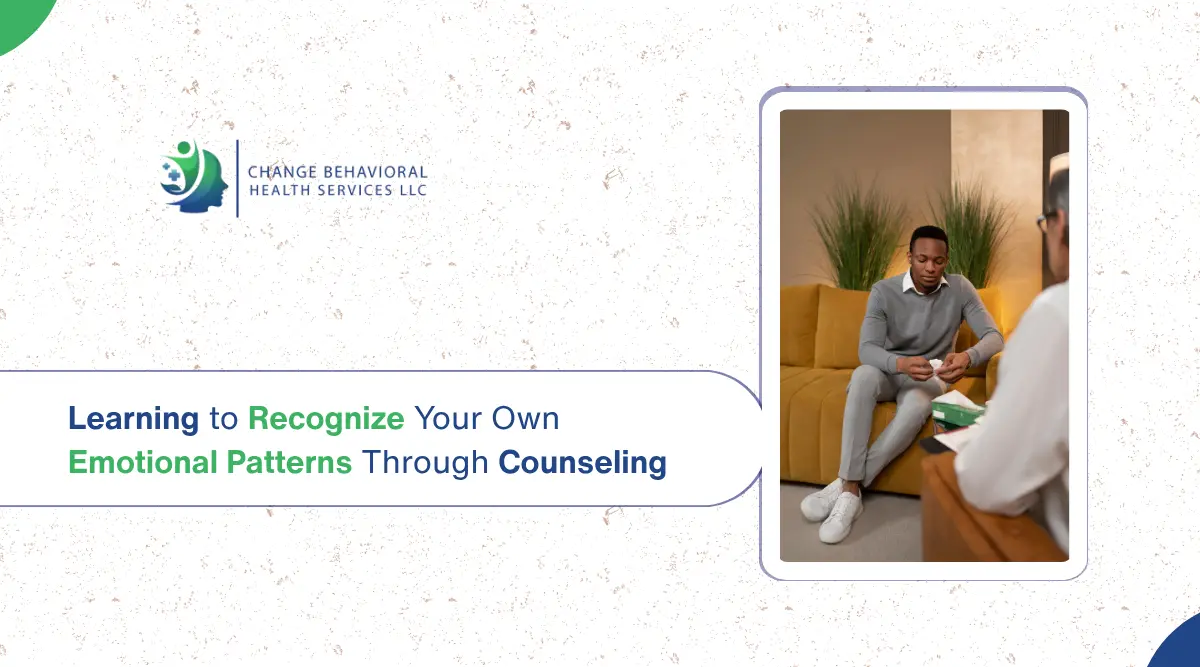
A counselor’s job is to sit outside the pattern while you describe it from inside. The outside view catches things the inside view misses.
Therapists trained in approaches like CBT, psychodynamic therapy or schema therapy are specifically looking for the automatic thought sequences that precede emotional reactions.
Not just what you felt but what you told yourself a split second before you felt it.
That moment is where the pattern lives and it’s usually so fast that most people never notice it happening.
Schema Therapy & Core Beliefs
Schema therapy in particular, developed by Jeffrey Young, targets what he calls early maladaptive schemas.
These are core beliefs about the self and others that formed during childhood and run as background assumptions in adult life.
Schemas like:
- Defectiveness. “I am fundamentally flawed.”
- Abandonment. “People I need will leave me.”
- Subjugation.“My needs don’t matter.”
These don’t show up as conscious thoughts. They show up as emotional reactions that feel completely situationally appropriate—until someone helps you see how often the same reaction appears across very different situations.
The Role of the Body
Emotional patterns aren’t only cognitive. They’re somatic:
- The stomach that drops before a difficult conversation.
- The chest that tightens when a particular tone of voice appears.
- The sudden exhaustion that comes from nowhere after a specific kind of interaction.
Somatic awareness – tracking where in the body an emotion registers and what physical state precedes a reaction – is increasingly part of how counselors work with emotional patterns, drawing on the work of clinicians like Bessel van der Kolk and Peter Levine. The body often signals the pattern before the mind has registered that anything is happening.
Why Insight Alone Doesn’t Change It
Most people who come to counseling already have a lot of insight. They know their mother was critical. They know they have abandonment issues. They know they shut down when they feel criticized. Yet, the knowledge doesn’t stop the pattern.
This happens because insight and behavior change run through different neural systems:
- Prefrontal Cortex. Handles intellectual understanding.
- Amygdala.Processes emotional reactions (particularly fear-based ones). It does not update based on what you know cognitively. It updates through the repeated experience of a different outcome.
Counseling, however, creates a safe, low-risk setting that allows people to examine their old behavioral patterns the moment they are triggered, rather than only reflecting on them after the fact.
What Recognition Actually Looks Like
In practice, recognition tends to be less dramatic than people expect. It’s rarely a sudden, cinema-style revelation. More often, it looks like:
- Noticing mid-argument that the feeling you’re having is the exact same feeling you had in a specific childhood situation.
- Catching the thought “here it is again” before you’re all the way inside the reaction.
- Having a distinct name for the pattern that makes it slightly less automatic.
Names matter more than people expect.
Research on affect labeling (studied by Matthew Lieberman at UCLA) found that naming an emotion reduces amygdala activation and increases prefrontal regulatory activity.
Calling the thing what it is, in the moment, changes the neurological response.
Key Indicators You’re Recognizing a Pattern:
- Noticing the same physical sensation before different but emotionally similar situations.
- Recognizing when a current reaction is disproportionate to the current event.
- Identifying the automatic thought that precedes the feeling.
- Seeing which situations consistently trigger which responses.
How Long It Takes
Pattern recognition is not linear. People often see their patterns more clearly before they can reliably change them. Seeing them more clearly can even temporarily make things feel worse rather than better because what was once automatic is now fully visible.
Research on psychotherapy outcomes suggests meaningful change in patterns requires sustained engagement over months rather than weeks, particularly for patterns rooted in early relational experience. Brief interventions can produce symptom relief, but changing how a person relates to themselves and others takes longer.
Change Behavioral Health Services
Change Behavioral Health Servicesprovides individual counseling, psychiatric assessments, and medication management services for adults in Gaithersburg, Maryland and the broader Washington-Maryland-Virginia (DMV) region.
All treatment is centered on individual needs. Clinicians use a range of evidence-based approaches including cognitive behavioral therapy, trauma-informed care and supportive therapy.
You are welcome to start a counseling conversation with us.
- Phone – (301) 732-7721
- Email – changebhservices@gmail.com
- Location – 18310 Montgomery Village Avenue, Suite 300 #1107, Gaithersburg, MD 20879
- Hours – Monday to Friday, 9 AM to 5 PM