You already know the cycle if you’re stuck in one.
Same trigger, same reaction, same regret afterward. A generic worksheet or a one size fits all program rarely touches it, because it wasn’t built around your specific trigger in the first place.
Custom treatment plansexist because behavior isn’t generic. The thing that sets off a pattern for you might not even register for someone else.
Why Behavior Loops the Way It Does
There’s actual neuroscience behind why these cycles feel so hard to break on willpower alone.
Researchers studying the basal ganglia have found that as a behavior becomes habitual, control shifts away from the prefrontal cortex, the part of the brain doing conscious decision making, into deeper structures that run more or less automatically. The behavior gets chunked into a routine the brain barely has to think about anymore.
That routine follows a pattern researchers call the habit loop. A cue shows up, it triggers a craving, the craving drives a response, and the response delivers some kind of reward. Repeat that enough times and the loop runs on autopilot.
This is exactly why “just try harder” falls flat as advice. It’s aiming at the wrong stage of the loop. The response isn’t really the problem. The cue and the craving driving it usually are.
Why Generic Programs Miss This
A standardized program treats every version of a behavior the same way, which sounds efficient right up until you notice it isn’t actually addressing anyone’s specific cue.
Two people can share the exact same diagnosis and still be dealing with completely different triggers, different rewards keeping the loop alive, and different life circumstances shaping how realistic any given change actually is. One person’s stress eating might be tied to loneliness. Another person’s might be tied to a work schedule that makes regular meals impossible. Same surface behavior, two entirely different loops underneath it.
Worth being honest here, since the research on personalization isn’t uniformly glowing. Some reviews of digital mental health tools have found that personalizing content alone doesn’t always produce a measurable difference in outcomes. What does show up consistently is that personalized human guidance tends to improve engagement and follow through, especially for people managing more severe symptoms. In plain terms, personalization isn’t magic on its own. It matters most when it’s paired with a real person adjusting the plan as things unfold, not just a form filled out once at intake.
What Actually Changes When a Plan Is Built Around You
A few things shift when treatment gets built around an individual instead of a generic protocol.
The cue gets identified specifically, not generically. A treatment plan built around you starts by figuring out your actual trigger, whether that’s a certain time of day, a specific person, a feeling, or a place, rather than assuming everyone with a similar diagnosis shares the same one.
The replacement routine actually fits your life. The most reliable approach to breaking a habit loop, according to behavior change research, isn’t erasing the cue or the reward. It’s swapping out the routine in between while keeping the same cue and reward intact. That substitute routine has to be something you can realistically do in the actual moment the cue hits, which means it has to be built around your real schedule, resources, and preferences, not a generic suggestion that sounds good on paper.
Readiness for change gets factored in honestly. Not everyone starts treatment in the same place mentally, and pretending otherwise sets people up to fail. A plan that accounts for where someone actually is, rather than where a program assumes they should be, tends to hold up better over time.
The plan adjusts as things change. A loop that gets identified in week one might shift by week six as other pieces of life change around it. A custom plan gets revisited and adjusted along the way, rather than running the same fixed protocol from start to finish regardless of what’s actually happening.
Co occurring issues get addressed together instead of separately. A lot of behavioral cycles are tangled up with something else entirely, anxiety, a substance use pattern, an underlying mood disorder. Treating just the visible behavior while ignoring what’s feeding it tends to leave the loop mostly intact, just waiting for the next trigger.
What This Looks Like Day to Day
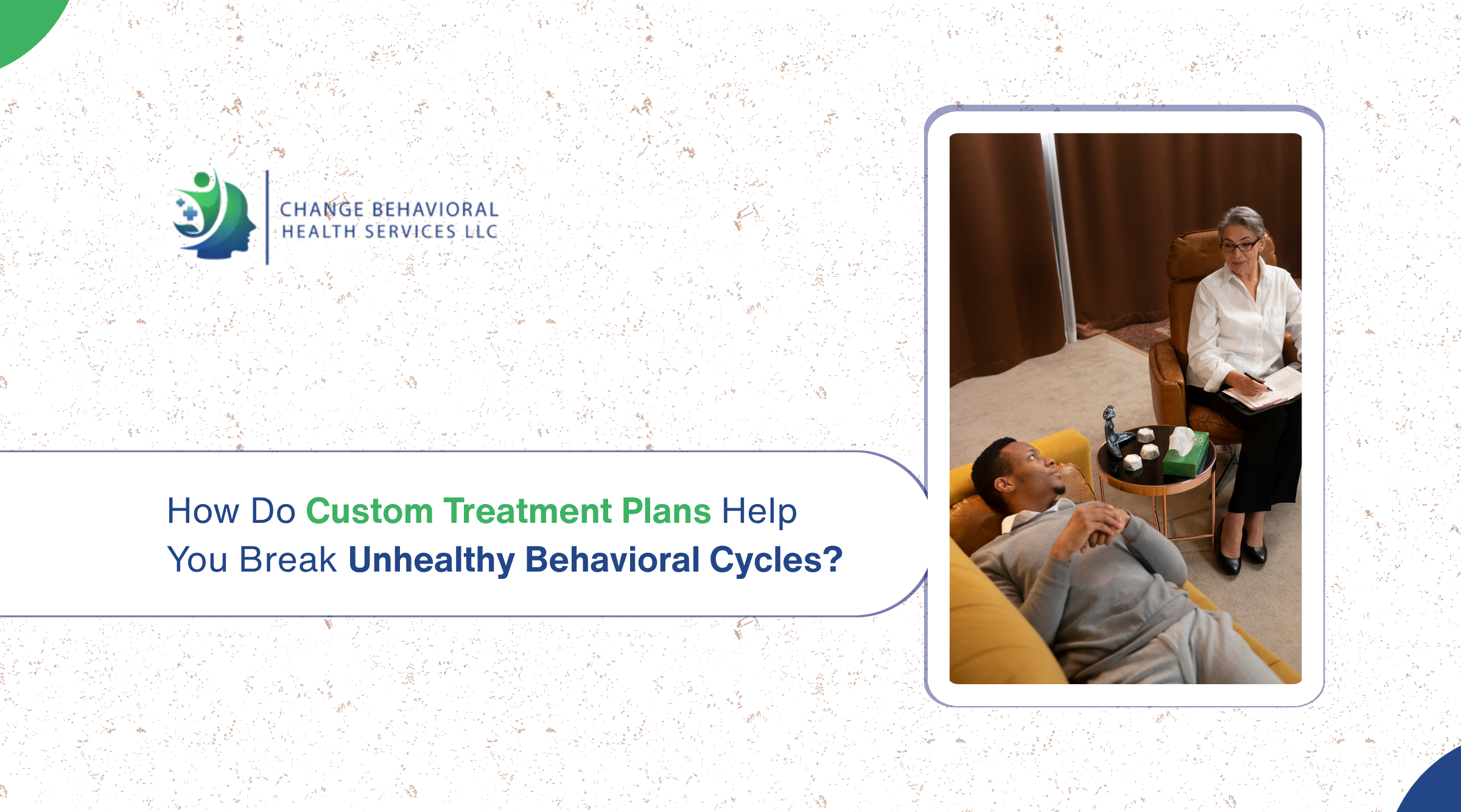
In practice, this usually starts with a real conversation about the specific behavior you’re trying to change and what actually surrounds it. Not a checklist. An actual mapping of what triggers it, what you get out of it even when it’s hurting you, and what’s realistically available to you as an alternative in that exact moment.
From there, a plan comes together, which can include individual therapy, antidepressant/anxiety medicationif there’s a clinical component to it, you might need psychoeducation so you understand the pattern itself and maybe more specific structured addiction treatment.
Why This Matters More Than It Might Seem
The problem with breaking a cycle of behavior is not really about willpower, and treating it this way only layers shame on top of an extremely irritating pattern.
If you find that your life is stuck on a pattern, even if you’ve done it a hundred times before and tried positive thinking to will yourself out of the pattern, then this warrants an actual conversation instead of another generic swing at fixing it.
Change Behavioral Health Services can help you construct a plan based on what truly influences your particular cycle. Contact usto book a consultation.