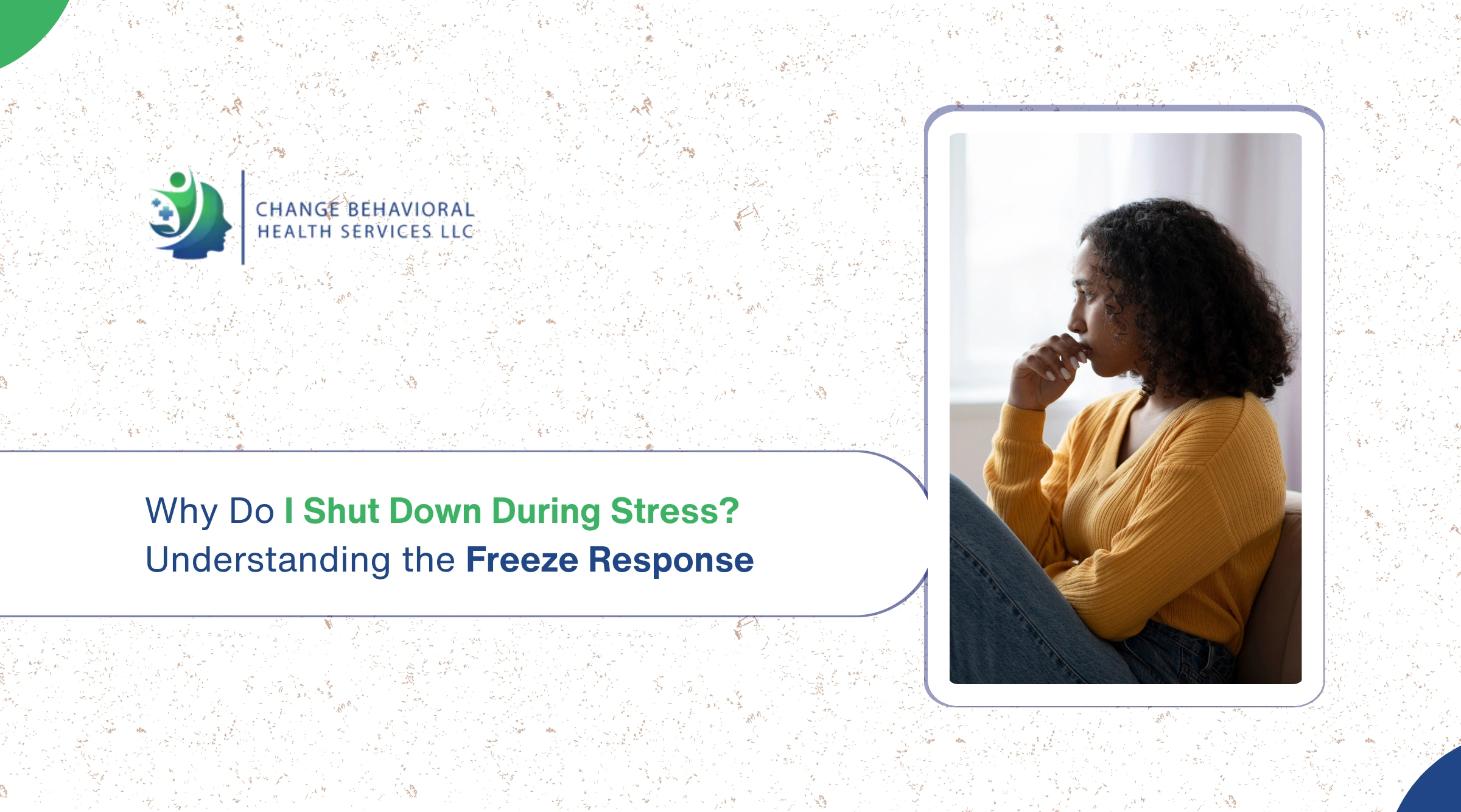
You know the feeling. Something stressful happens a rough talk at work, a family fight, a surprise expense, or just the slow buildup of daily strain and instead of feeling mad or wanting to run, you go blank. Your thinking is cloudy. Your body feels heavy. Language vanishes. The motivation is gone. You can be sitting there looking at your phone or the wall, knowing you should do something, but you can’t move ahead.
If this resonates, you are not broken, lazy, or “just not trying hard enough.” What you are experiencing is commonly the freeze response, a natural survival response that many people don’t talk about as much as the fight-or-flight response. It’s normal, especially when you feel like stress is too much or unavoidable. Knowing about it might help you feel less ashamed and offer practical methods for working with your nervous system rather than against it.
What Is the Freeze Response?
The freeze response is your body’s natural way of safeguarding you when it senses danger and believes that fighting back or fleeing away is not an option or safe. Imagine a deer in headlights or a rabbit frozen in place while a predator is near. At such times, silence is often the best choice. It lowers the chances of detection and conserves energy.
In humans, freezing can take numerous forms, depending on its strength. It might be a tense moment where you’re locked in place in the middle of an argument, or you’re blanking in the middle of a presentation. Often, extended or chronic stress takes the form of functional freeze: you do the things you’re supposed to do work, parent, answer messages while underneath you feel numb, detached, fuzzy, or trapped. You’re running externally, but your system has dropped involvement as a self-preservation tactic.
This is not a purposeful choice. It happens below the level of conscious thought. It happens due to your autonomic nervous system.
Why Does the Freeze Response Happen?
Your nervous system constantly scans for safety and hazard. This process is called neuroception at times.
When it detects danger, it follows a hierarchy of responses shaped by evolution. The first thing when things are safe is social participation and connection. When a threat looms, and it seems like action is conceivable, the sympathetic nervous system activates fight or flight. A surge of energy, an increase in heart rate, and muscles primed for action.
But when the threat is too much, for too long, or inescapable, when fighting or escape appears impossible, the system can switch to an ancient pathway. This means the dorsal vagal complex, leading to immobilization, shutdown, or freeze.
This stage puts the body in conservation mode. Energy is preserved. You can become less sensitive. Thinking might constrict or go offline. It is the nervous system’s last recourse, like animals that play dead or go limp in the face of overwhelming harm.
One important paradigm for understanding this hierarchy is polyvagal theory, created by researcher Stephen Porges: first safety and connection, then mobilization, and last shutdown as the deepest protective response when the others are not accessible.
Everyday stressors that we experience now can activate the same circuitry that once safeguarded our ancestors from predators. So, if you are always overwhelmed, helpless, have unresolved issues in the past, or feel powerless in any situation, your system will freeze because it was the safest option. When we are under extreme stress, the prefrontal cortex (the part of the brain responsible for planning and clear thinking) might shut down, and more primitive threat-detection regions take over. And there is the familiar feeling of shutting down.
Crucially, freeze is not the same as plain exhaustion or lack of drive. It is a condition of physiology. Whether the “threat” is an overcrowded email, a challenging relationship, or a literal predator, your body is trying to protect you.
Common Signs You Might Be in Freeze
Freeze can happen in the body, mind, and behavior. Some people feel it more physically; others more as a mental or emotional shutdown. Common experiences are:
- Feeling fuzzy, blank, or unable to think straight
- Feelings of heaviness, numbness, or detachment from your body or emotions
- Difficulty starting chores, especially tasks that typically feel manageable
- Getting stuck/paralyzed in conversations and decision-making
- Absence of sensation or a sense of seeing life from the sidelines
- Low energy or motivation that rest alone cannot fully resolve
- Feeling like you are on autopilot and detached from the regular rituals
- Postponing or avoiding non-urgent things that feel overwhelming
In more acute occasions, people sometimes say they feel like a deer in headlights, unable to talk or move even when they want to. Afterwards, shame typically follows (“Why didn’t I say something?” or “Why can’t I just get it together?”). That self-judgment can create the loop, because the nervous system perceives criticism as a greater threat.
Freeze Compared with Fight, Flight, and Fawn
The fight, flight, freeze, and sometimes fawn responses are all evolved tactics for survival. Fight directs energy to confrontation. Flight is energy sent forth to go away or to stay away. Fawning is about appeasing or people-pleasing to reduce threat. Freeze is the immobilization choice when action doesn’t feel available.
None of these is, per se, “bad.” Problems develop when they become automatic defaults in settings when they are no longer appropriate, or when freeze becomes a chronic state that interferes with daily living and relationships. Many people waver between answers based on the circumstances and their history.
Why Some People Experience Freeze More Readily
A history of feeling helpless or trapped can sensitize the neurological system to freeze. This could include childhood contexts where it was not safe to voice needs or fight back, continual high-demand conditions with little time to recuperate, trauma, or periods of chronic stress with no release. This can be especially true for high-achieving or very responsible people, who often power through with productivity until the system finally reaches its limit and switches into conservation mode.
The nervous system learns patterns from past experiences. What once saved your life can be triggered in normal stressful situations. The good news is that our neurological systems remain changeable. With awareness and support, new ways of safety and regulation can be established.
Practical Ways to Work with the Freeze Response
Freeze is a state that is body-based; thus, solely cognitive remedies (“just push through” or “think positive”) typically fall short and can even compound the sense of failure. The softer, body-based approaches tend to perform best. The idea is not to push yourself out of frozen but to indicate safety and slowly bring in greater energy and presence.
Many people find the following ways helpful:
- Start small with movement. Even rising slowly, stretching your arms, wandering to another room, or just gently shaking your hands and feet can start to alter the system. When you are shut down, little activities are more important than massive ones.
- Use breath to indicate safety. Longer exhales tend to stimulate relaxing pathways. Breathe in to a comfortable count. And out a little bit longer. There is no need to force deep breathing if it feels hard; gentle is OK.
- Orient to the present. Gently absorb a few neutral or pleasant characteristics in the room-the color of a wall, the feel of a chair, a sound in the distance. This helps the nervous system feel that you are here, now, and relatively safe.
- Engage the senses, delicately. Warm liquids, cool water on your face or wrists, soft textures, or walking outside for a moment of fresh air or natural light are grounding cues.
- Less self-pressure. Generally, the more pressure, the greater the feeling of threat. Rather than demanding productivity, attempt to acknowledge the state: “My system is currently protecting me.” Compassion lowers secondary stress.
- Create micro-moments of safety throughout time. Little habits, such as taking a walk, being among people who support you, having a predictable routine, or engaging in slightly pleasurable things, can increase your capacity, so that freezing is less automatic.
- Try to connect when you can. Social connection in safe ways can assist in controlling the neurological system. Even a quick note to someone steady or sitting with others without the pressure to perform can help make a difference.
Progress is rarely linear. Some days the strategies will feel more accessible than others. The aim is gradual re-engagement, not perfection.
When Professional Support Can Help
Occasional freezing under acute stress is common, and usually resolves as the stressor is removed. But if shutdowns are occurring frequently, for extended periods of time, or are interfering with job, relationships, self-care, or everyday functioning, professional help can make a substantial impact.
Working with the body and neurological system, whether through trauma-informed therapy, somatic approaches, or other evidence-based care, can assist in processing underlying patterns and establishing more regulation.
Change Behavioral Health Services provides a complete array of person-centered services for persons experiencing mental health issues, stress, and more. Services include psychiatric diagnosis and medication management, psychoeducation, and counselling, and are provided by telehealth and in select venues around the Washington, D.C., Maryland, and Virginia area. Our staff is committed to providing compassionate, individualized support to help people progress towards greater stability and well-being.
If freeze feels like a constant aspect of your existence, reaching out is a step towards understanding and change, not weakness.
Moving Forward with More Understanding
When you’re overwhelmed, shutting down doesn’t indicate something’s wrong with you. That indicates your nervous system is doing what it was built to do when it sees restricted options. Understanding the freeze response might help you replace self-criticism with curiosity and self-compassion. From there, gentle, consistent activities and the correct support can help your system understand that there are more choices available: connection, gentle action, and a stronger sense of safety.
You get to go at the pace your neurological system can handle. Often, understanding is the first step to feeling more present and capable again. If this sounds like you, please consider looking into resources and contact us to schedule a consultation. Relief and greater ease are possible.
FAQs
Is stress-induced freezing the same as laziness or depression?
No. Freezing is a physiological survival mechanism, not a character defect or a lack of resolve. It can present itself as low motivation or depression-type symptoms, but typically the underlying issue is the nervous system going into defensive shutdown, not just plain exhaustion or a mood disorder in isolation.
Can I stop the freeze response from even happening?
You might not be able to get rid of it totally; it’s a programmed survival mechanism, but you can minimize the frequency and intensity of it. By raising awareness, working on gentle regulating skills, and treating underlying stress or experience, your system can begin to feel safer and adapt with more flexibility over time.
What is the difference between freeze and fight-or-flight?
Fight and flight are mobilization responses that raise energy to face or escape. Freeze is the opposite: when action feels impossible or unsafe, the system freezes. Both are protective but feel very different in the body and mind.