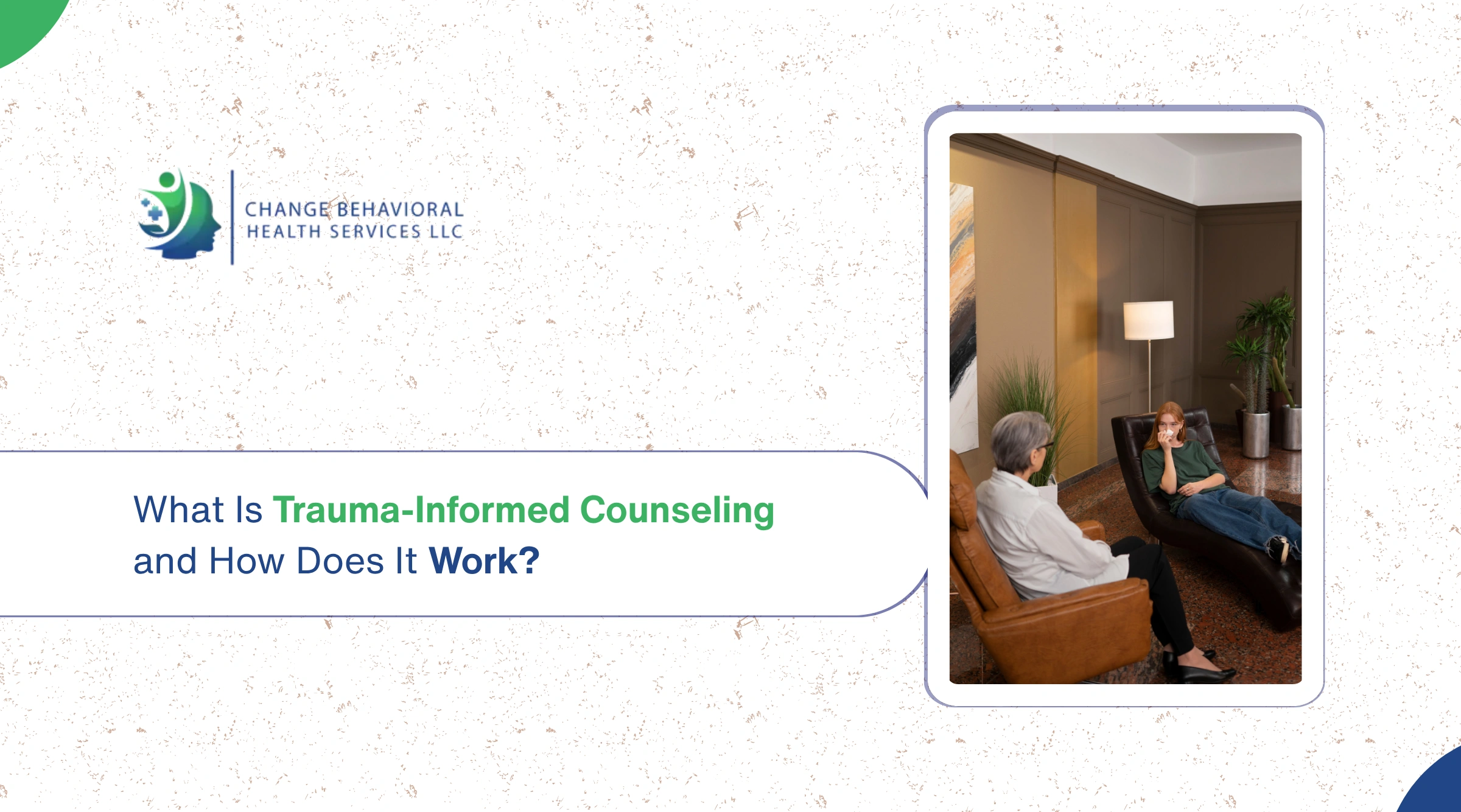
Trauma-informed counseling understands that experiences of loss, neglect, violence, betrayal, and chronic stress can impact a person’s feelings, relationships, and sense of safety long after the event. It doesn’t only look at symptoms, but also at how prior events influence current issues. This method promotes safety, dignity, collaboration, and the individual’s pace, and moves the focus from “What is wrong with you?” to “What happened to you, and how has it shaped you?” At Change Behavioral Health Services, this approach prioritizes dignity, collaboration, and the person’s own pace rather than pushing for quick symptom reduction at the cost of emotional safety.
What Trauma Really Means and Why It Matters in Counseling
Trauma is the enduring imprint of experience that exceeds an individual’s capacity to cope. It can be one big traumatic event or a succession of lesser injuries that build up over time. The body and mind react with extreme vigilance, numbing feelings, or defensive behaviors that were useful for survival but later cause challenges in daily living.
These can show up as abrupt irritation, difficulty trusting people, problems concentrating, sleep disturbances, physical tension without an apparent medical cause, or a desire to retreat. They are not moral deficiencies. These are adaptations that used to be sensible. Trauma-informed counseling knows this from the first conversation. Instead of seeing such adaptations as the central issue, the counselor attempts to understand them, decrease their intensity, and help the individual find other ways to feel safe and connected.
Not all difficult experiences lead to long-term traumaresponses. The result is affected by support structures, personal resilience, and the nature of the incident. Yet when permanent impacts do emerge, failure to address them can leave people trapped in cycles that conventional methods sometimes fail to acknowledge.
The Guiding Principles That Shape Every Session
Trauma-informed counseling is grounded in a series of fundamental values that influence the counselor and the entire setting. These principles establish a context in which a person is less likely to feel controlled, dismissed, or re-wounded by the very process designed to assist.
- Safety is the top priority, both physical and mental. The room is predictable. Limits are imposed. The counselor is aware of what can be triggering and adapts accordingly. People are asked to speak about what they need to feel comfortable.
- Trustworthiness and transparency heal what trauma often harms. The counselor explains what is going on, honors promises, and maintains open, honest communication. Surprises are reduced.
- Collaboration replaces hierarchy. Goals, subjects, and pace are agreed upon collectively. The person is viewed as the expert on their own experience.
- Empowerment and choice help reestablish a sense of agency often stripped away by trauma. At every stage, the person has important choices to make: What to disclose, how far to go, what techniques to employ.
- Cultural and historical consciousness: Trauma does not happen in a vacuum. A person’s experience of suffering and what healing looks like for them is shaped by their background, identity, experiences in community, and larger social factors.
These ideas are not only proclaimed but lived. They show up in the tone of the room, the language used, the organization of sessions, and respect for the person’s timeline.
How the Work Actually Unfolds
Trauma-informed counseling doesn’t start by going directly into the most painful memories. This can be a way of overwhelming a person before they have the means to stay grounded. The procedure normally occurs in a step-wise manner with an emphasis on stability.
The first conversations are around developing safety, finding out and understanding struggles. The counselor and client look at what brought the individual to seek help, what strengths the person already has, and what daily life is like for the person. Learning how the nervous system responds to threat often helps people feel less alone and less “broken.” It can offer a pathway to healing. The individual is exposed to simple practices like paying attention to the present moment through the senses, steady breathing, or gentle ways to relax the body so they have reliable ways to work with powerful feelings.
The therapy goes further only if there is a foundation of trust and coping capacity, and only if the person desires that. The processing is done at a speed that respects the person’s window of tolerance. The counselor pays close attention to any signals of overwhelm and slows things down or changes direction as necessary. Techniques from a variety of useful approaches can be applied, always filtered through the dedication to safety and collaboration.
In the process, the relationship itself is part of the healing. Ongoing respect, real interest, and shared power provide a lived experience of connection that is different from previous experiences of helplessness or isolation.
People typically walk away from meetings with practical skills they can utilize between appointments:
- How to spot early indicators that the body is going into high alert or shutting down
- Personalized grounding techniques that match their daily life
- Gentle techniques to question old beliefs that don’t benefit them anymore
- Small activities that reestablish a sense of choice and self-trust
- Ideas on how to build more supportive ties outside of therapy
Progress usually doesn’t go in a straight line. And there is understanding, not judgment, for tough days. The focus remains on the individual’s capacity to heal and the slow reappropriation of a life that feels more their own.
How This Differs from More Conventional Counseling
Most traditional treatments are more about recognizing symptoms, investigating cognitive processes, and providing coping skills. The counselor is more likely to be directive and expert. This helps a lot of people.
Trauma-informed counseling maintains helpful techniques, but shifts the context around them. Rapid symptom checklists are less important than the quality of the relationship and safety. We carefully seek to minimize the risk of unintentionally reproducing dynamics of control or unpredictability. There is more room for cultural context and personal history. The person is never seen as a series of issues to be solved, but as a whole human being whose responses are understandable given what they have gone through.
Who This Approach Can Help
Everyone can benefit from care that is safe, respectful, and collaborative. Individuals with obvious histories of overpowering experiences frequently feel especially seen. Anxious people, those who are down, those with substance issues, marital issues, or chronic stress issues may find that unresolved trauma is contributing to their current problems. Even those who would not point to one particular occurrence can sense the difference when their counselor considers the possibility of past hurt and develops the approach around it.
This perspective is important since trauma responses can be so many different mental health disorders, and this helps to guarantee that the deeper layer is not missed.
Taking the Next Step
When seeking counseling, it is okay to inquire how a provider handles safety, choice, and the likelihood of trauma. The practices that take these concepts seriously integrate them into day-to-day interactions and not only in infrequent utterances. This foundation is the basis for the greater purpose of supporting people to manage emotional, social, and behavioral issues with dignity and true partnership in person-centered mental health support practices such as Change Behavioral Health Services.
Healing is not about removing the past. It means the past no longer propels the present. Trauma-informed counseling is a way of honoring the whole complexity of a person’s story while always holding the prospect of increased safety, connection, and self-direction.
If you are ready to explore trauma-informed counseling or simply want to learn more about how this approach might support you, we invite you to reach out. Contact Change Behavioral Health Services today to start a conversation about the care that feels right for you.
FAQs
Is this only for people who have been diagnosed with PTSD?
No. It is a way of working for anyone whose life has been affected by overwhelming experiences, whether formally diagnosed or not.
Do I have to talk about the hardest memories right away?
No. First, we build safety. And practical coping strategies. Deeper processing only occurs when the person is ready and chooses to do so.
How is the experience different from regular talk therapy?
The difference is most apparent in the emphasis on safety, collaborative decision-making, and a careful attention to preventing the re-creation of previous harm. The relationship, as well as the environment, are looked after as much as the precise procedures used.
Can this help if I am also dealing with substance use or other challenges?
Yes. Trauma and other issues typically go hand in hand. Working through the effects of trauma can aid in broader recovery and well-being.